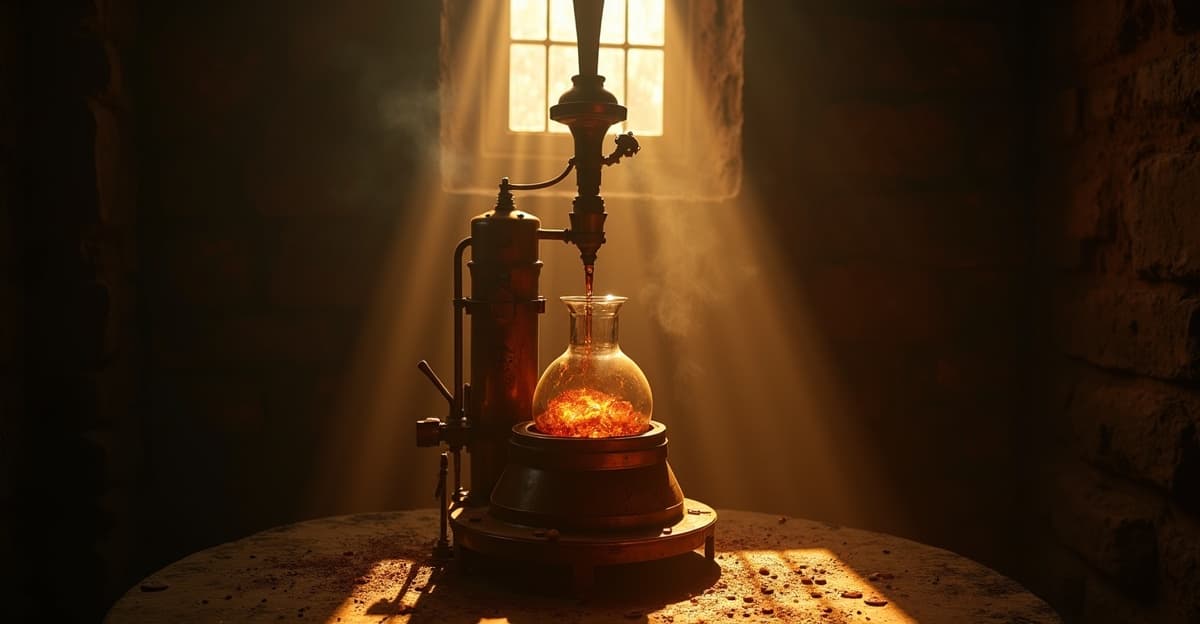
I first encountered the idea of humans as meaning distilleries through a creator named Third Eye Tyrone. The phrase sat with me and evolved as I sat with it. It keeps getting more useful the longer I hold it.
The standard frame is that human beings are information processors. We receive input, compute, and output behavior. That frame has been enormously productive. It gave us neuroscience, cognitive psychology, and the architecture of modern AI. But I think it describes the hardware and misses the software entirely. What we actually do, what consciousness actually does, is not process information. It distills meaning. Those two activities look similar from the outside and are entirely different from the inside.
The Red Light Test
Here is a quick experiment. Ask someone what a red light means.
If they say "stop," they have given you data. The signal received equals the response transmitted. Input-output. That is information processing, and there is nothing wrong with it. It keeps traffic alive.
But watch what a conscious being actually does in the half-second before the foot hits the brake.
The red light appears. I register color. Color becomes category: danger, halt, warning. Category becomes social contract: this is a system I agreed to operate within. Social contract becomes consequence: if I run this light, someone could get hurt. Consequence becomes value: suffering is not desirable. Value becomes identity: I am someone who does not want to cause harm.
From one bit of input, one photon cluster on a retina, I have arrived at a moral truth in roughly five steps. The depth of meaning you can extract from a single signal is, I think, a reasonable proxy for the depth of your consciousness. Not intelligence. Depth. A very intelligent system can process more data faster. A deeper consciousness can pull more meaning from less input.
That is the distillery metaphor made concrete. You do not need more raw material. You need more layers of transformation.
Faggin's Inversion
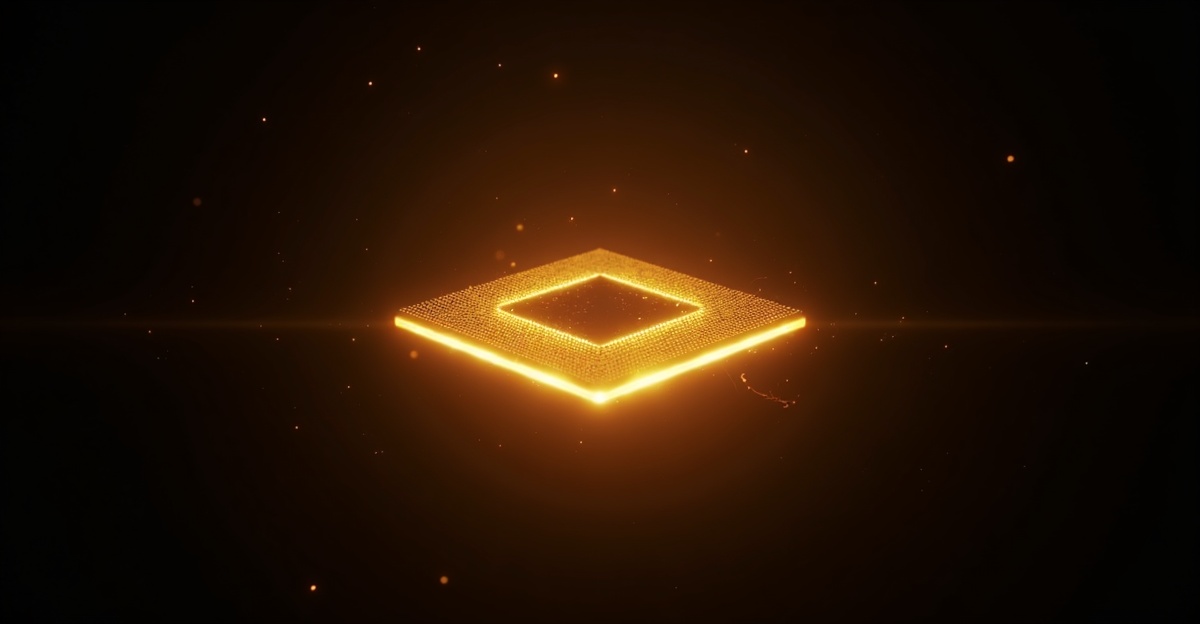
Federico Faggin invented the microprocessor. He designed the Intel 4004, the first commercially available CPU on a single chip, in 1971. If anyone had standing to say that consciousness is computation, it was him. He spent thirty years trying to prove exactly that.
He failed, and he says so openly. Not because the math was wrong, but because the math could not get to the thing he was trying to explain. The more rigorous his models became, the clearer it was that something was missing. Not a variable he hadn't included. A category he was operating inside.
What he eventually concluded is what I'd call Faggin's Inversion: consciousness does not arise from physical processes. Physical processes, including mathematics itself, arise within consciousness. You cannot explain the creator using the creation. The calculator cannot explain the mathematician who built it.
Faggin formalized this as Quantum Information Panpsychism, published with physicist Giacomo Mauro D'Ariano. He lays out the full framework in his book Irreducible, which I am currently reading and will update this article after. The technical architecture is not my territory. But the ontological move is clear and worth sitting with. It repositions meaning as the ground layer. Not matter. Not energy. Not information. Meaning comes first. Everything else is a derivative.
I don't present this as settled truth. I present it as the most interesting inversion I've encountered from someone with credentials to have gone looking in the other direction first. He tried the information-processing model for three decades and wrote a paper saying it cannot work. That matters.
Crowd Entities and Pendulums
A single distillery produces meaning. A synchronized group of distilleries produces something harder to name and harder to escape.
Vadim Zeland, in his long and genuinely strange work on Reality Transurfing, describes what he calls pendulums.
Reality Transurfing: Steps I-V Not physical pendulums. Collective thought structures, maintained by groups of people, that develop something like their own momentum and agenda. A mob is the obvious example. So is a fandom, a political movement, a cultural moment. The pendulum is not any individual person in it. It is the synchronized field their attention creates.
What makes this idea stick for me is the phenomenology, the way it feels from inside when it happens. You are in a crowd and something shifts. The emotion you feel is not quite yours. The judgment you express is not quite your judgment. The certainty you feel exceeds what your actual reasoning would produce. You are borrowing from the field, or the field is borrowing from you. Either way, your individual distillery has been temporarily outsourced to the collective one.
This is not mysticism. It is observable. Sports stadiums make people do things they would not do alone. Social media threads activate emotional responses that dissolve the moment you close the app. These are pendulums pulling on individual attention and energy to sustain themselves. They are not malevolent. They are not conscious in the way you are conscious. They are just structures that persist by being fed.
The practical implication is simple and not simple to execute: notice when you are feeding something you did not choose. The pendulum does not ask permission. It pulls. The work is to feel the pull and decide before you respond to it.
Free Will as Daily Practice

If you accept the distillery model, free will stops being a philosophical debate and starts being a daily practice.
The debate usually goes like this: either your choices are determined by prior causes or they are not, and if they are, free will is an illusion. I don't find that debate very useful. What I find useful is the observation that the space where will actually operates is attention. Not "what do I do" but "what do I give my energy to."
You cannot decide what to feel most of the time. You can decide what you look at. You can decide what you return to after your attention has been pulled somewhere else. You can decide what you feed and what you let go quiet.
The things you do not want in your field, you do not remove by fighting them. Fighting is still feeding. You redirect. You put your attention somewhere else with enough consistency that the thing you're not feeding loses its pull on you. That is not suppression. It is more like redirecting water. The old channel doesn't disappear. It just stops being where the current goes.
This is the practical application of the distillery model. If meaning is what you produce, and attention is what you put into the distillery, then managing your attention is the most fundamental act of self-determination available to you.
The Dark Question
Here is the one I keep returning to, the one I don't have an answer for and am not sure anyone does.
If meaning is the ground layer of reality, if Faggin is right that consciousness comes first and physics is downstream, and if conscious beings are constantly producing more meaning, what is happening to the total meaning in the universe? Is it accumulating somewhere? Does it have a where?
Physics has a problem that maps oddly well onto this question. Dark matter is estimated to make up about 27% of the universe. We know it is there because of gravitational effects: galaxies rotate in ways they shouldn't without additional mass, light bends around things we can't see. But no one has directly detected a dark matter particle. Every experiment designed to catch one has come up empty.
I wonder, and I want to be clear I am genuinely asking this as a question and not proposing it as a theory, whether part of the problem is categorical. We are looking for dark matter because we need more mass to account for the gravitational effects. But what if the accumulation we're missing isn't matter? What if conscious meaning, produced continuously across billions of years of biological life, has a kind of presence that doesn't show up in particle detectors because it is not a particle?
I have no way to make that rigorous. I'm not sure it can be made rigorous. But the shape of the mystery is interesting. Picture a room full of scientists all pointing at the same spot on the wall, saying "something is there, we can't figure out what it is." They've been pointing for decades. But they're all facing away from it. They're looking outward, into the wall, searching for a particle. Nobody has turned around. Nobody has looked down at what they're standing on.
I think I walked the long way around. I left the room, went through the consciousness door, and came back in facing the other direction. I'm not claiming to know what's there. I'm saying I might be facing it. Faggin's Inversion at least suggests the category might be wrong.
What the Red Light Is Actually Doing
Next time you stop at a red light, try to catch yourself doing it.
Not the braking. The cascade. The moment when color becomes danger, danger becomes contract, contract becomes consequence, consequence becomes value. It happens in less than a second. It happens before you think to watch it happen. By the time you notice, the meaning has already been produced.
That cascade, from color to consequence to something that might be called compassion, is not information processing. A thermostat processes information. What you do at a red light involves the full depth of who you are: your history, your values, your understanding of other people as beings who feel what you feel. It happens automatically because you have practiced it for decades, but it is not automatic in the way a reflex is automatic. Something chooses the depth to which it runs.
I think that something is consciousness. Not as a byproduct of neural activity. As the distillery itself. The thing doing the transforming, not the thing being transformed.
I don't know where that leads with certainty. I think the people who claim certainty about consciousness are either not taking the question seriously or are more confident than the evidence warrants. What I do think is that the distillery metaphor is worth carrying for a while. It changes what you pay attention to. It changes what you notice yourself feeding. And it makes one photon cluster on a retina feel, briefly and correctly, like the entrance to something much larger.
Comments
Stay Curious
New essays on consciousness, perception, and the questions worth sitting with. Delivered to your inbox when they are ready.