The Case Against Reality
Synopsis
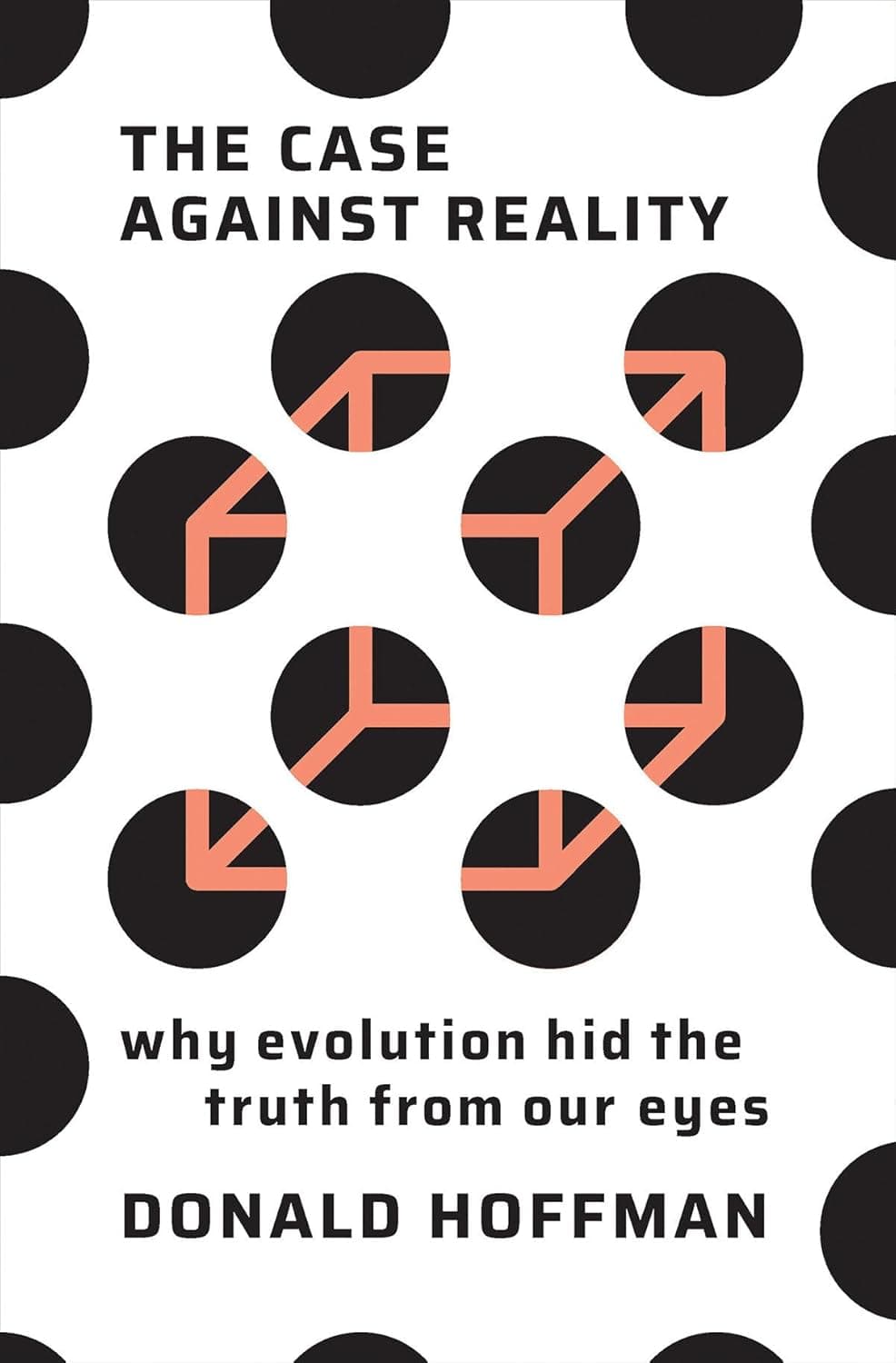
The Case Against Reality presents cognitive scientist Donald Hoffman's radical argument that evolution has shaped our perceptions to hide reality rather than reveal it. Using evolutionary game theory and mathematical modeling, Hoffman demonstrates that organisms tuned to fitness rather than truth consistently outcompete those that perceive reality accurately. Our senses function like a desktop interface, showing us useful icons and simplified representations while concealing the underlying complexity. What we call physical objects, space, and time are species-specific user interfaces, not objective features of reality itself. Hoffman goes further, proposing that consciousness, not spacetime or matter, is fundamental, and develops a mathematical framework of "conscious agents" interacting to generate what we experience as the physical world. The book challenges the deeply held assumption that our perceptions correspond to anything resembling objective reality, backing provocative claims with rigorous scientific reasoning and empirical evidence from evolutionary biology, neuroscience, and perceptual psychology.
Philosophical Vectors
Personal Synthesis
"The Case Against Reality dismantled my confidence in perception more thoroughly than I expected. Hoffman's central argument is unsettling: evolution doesn't care about truth. It cares about survival. And those two goals aren't just different, they're often contradictory. His mathematical simulations show that organisms optimized for fitness beat truth-seekers every time, which means natural selection actively shaped us to not see reality as it is. The desktop interface metaphor clarified something I'd sensed but couldn't articulate. We don't see pixels and voltage when we use a computer. We see icons that hide complexity and let us interact efficiently. Hoffman argues perception works the same way. The apple, the tree, even space and time itself are simplified icons our species uses to navigate fitness challenges. They're real in the sense that they're consistent and useful, but they don't correspond to the actual structure of reality. What makes the book compelling is Hoffman's scientific grounding. He's not speculating wildly. He's building models, running simulations, and drawing on decades of research in evolutionary biology and perceptual science. The conscious agents framework feels ambitious, maybe even too ambitious, but he develops it with mathematical precision rather than hand-waving. The implications are profound. If spacetime is just our interface, not fundamental reality, then everything physics tells us describes the interface, not what's underneath. Consciousness isn't something brains produce. It's the other way around. That's a complete inversion of the standard materialist picture, and Hoffman makes a disturbingly convincing case for it. Some sections get technical, particularly when he delves into the mathematics of conscious agents, but the core argument is accessible and deeply challenging. This book didn't just change how I think about perception. It changed what I'm willing to assume about the nature of reality itself."