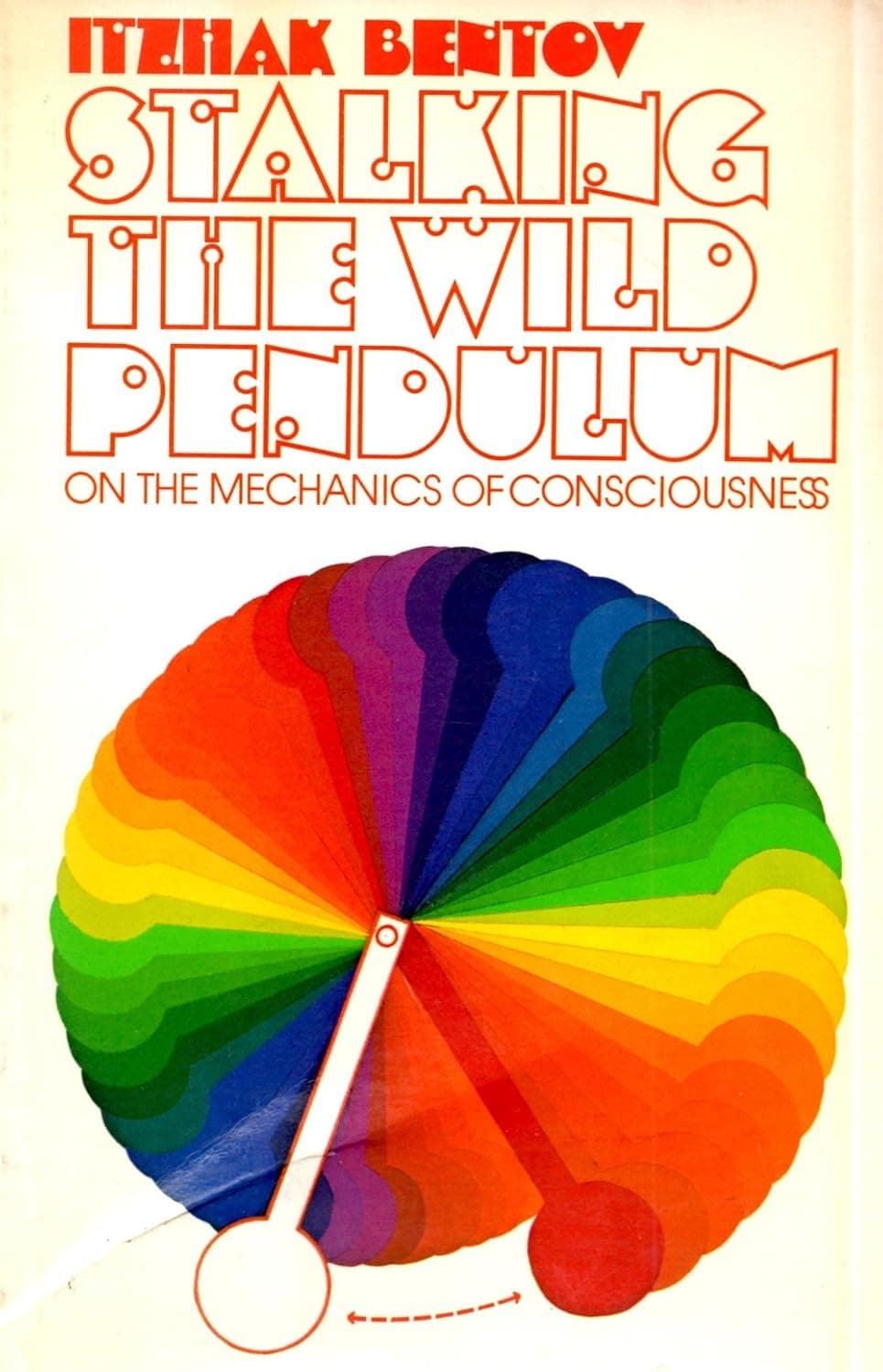
Stalking the Wild Pendulum: On the Mechanics of Consciousness
Synopsis
Stalking the Wild Pendulum is Itzhak Bentov's exploration of consciousness using models drawn from physics, particularly vibration, resonance, and wave phenomena. Bentov, an inventor and engineer, approaches mystical experiences and altered states not as supernatural events but as natural phenomena explainable through scientific principles. He uses pendulums, standing waves, and oscillating systems as metaphors to explain meditation, kundalini awakening, chakras, and expanded states of awareness. The book proposes that consciousness operates through rhythmic patterns and that tuning these rhythms through practices like meditation allows access to different levels of reality. Bentov bridges Eastern mysticism and Western science without reducing one to the other, suggesting they describe the same territory from different perspectives. He explores how the brain generates consciousness, how individual awareness connects to universal consciousness, and what happens at the boundaries of ordinary perception. The writing is accessible despite technical concepts, filled with hand-drawn diagrams that illustrate abstract ideas. It's playful and curious, treating consciousness as something to investigate and model rather than something beyond understanding.
Philosophical Vectors
Personal Synthesis
"Stalking the Wild Pendulum gave me a framework for understanding experiences I'd written off as purely subjective. Bentov takes states of consciousness that mystical traditions describe in poetic or religious language and models them using physics. The approach feels refreshing because he's not dismissing either science or spirituality. He's showing how they might describe the same phenomena from different angles. The pendulum metaphor worked beautifully for me. Bentov demonstrates how coupled oscillators synchronize, how standing waves create stable patterns, and how these principles apply to consciousness itself. Meditation, in his model, is about tuning your internal rhythms to resonate with larger patterns. Kundalini awakening isn't mystical energy but a measurable shift in the nervous system's oscillatory patterns. Chakras correspond to areas where different frequencies concentrate and interact. What made this compelling was Bentov's background. He wasn't a philosopher theorizing from an armchair. He was an inventor who approached consciousness like an engineering problem, building models and testing them against both scientific principles and direct experience. His explanations of how the brain generates standing waves, how these interact with the body's other rhythmic systems, and how altered states emerge from these interactions felt grounded in a way most consciousness literature doesn't. The section on the absolute was particularly striking. Bentov describes a state beyond space and time where individual consciousness merges with universal consciousness, but he models it using concepts like infinite frequency and zero wavelength. He's not romanticizing it or making vague gestures toward ineffability. He's attempting to map it using the same principles that explain everything else. His discussion of reality as holographic anticipated ideas that became more mainstream later. He proposes that each part of the universe contains information about the whole, that consciousness and matter are different aspects of a unified field, and that what we experience as solid reality emerges from interference patterns at more fundamental levels. These weren't idle speculations. He built them from principles he could demonstrate with pendulums and waves. The hand-drawn diagrams are essential. Some concepts would be nearly impossible to follow in text alone, but Bentov's simple illustrations make complex interactions visible. The playfulness in his drawings matches the tone of his writing. He's clearly delighted by what he's discovering. Not everything landed perfectly. Some leaps between physics and mysticism felt more metaphorical than literal, and I occasionally wondered if he was stretching analogies beyond their explanatory power. But even when I wasn't fully convinced, the models were useful for thinking about consciousness in new ways. Stalking the Wild Pendulum shifted how I understand meditation and altered states. Instead of seeing them as escapes from reality or purely psychological phenomena, I see them as tuning into frequencies and patterns that are always present but usually filtered out by ordinary awareness. Bentov's approach validated both my rational mind and my direct experiences without requiring me to choose between them. That integration is rare and valuable."