My Big TOE: Discovery
Synopsis
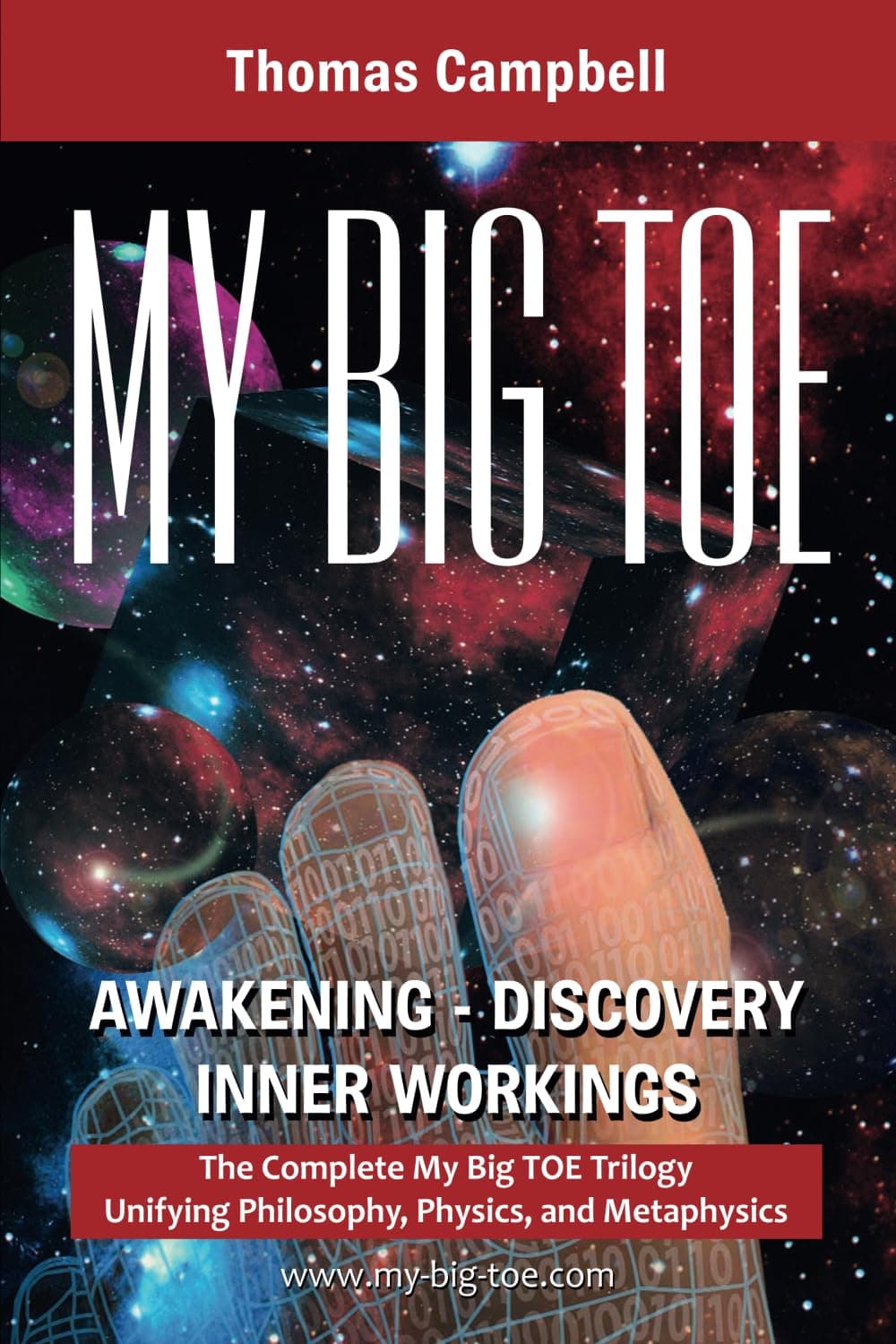
My Big TOE: Discovery is Thomas Campbell's account of how a physicist arrived at a comprehensive theory linking consciousness, reality, and existence. Campbell begins with his early experiments in altered states of consciousness at the Monroe Institute, where he systematically explored out-of-body experiences and non-physical reality. Rather than dismissing these experiences as subjective hallucinations, he approaches them with scientific rigor, treating consciousness as something that can be studied and mapped. The book chronicles his gradual realization that consciousness isn't a byproduct of physical processes but the fundamental substrate from which physical reality emerges. He builds toward a framework where our material world is essentially a virtual reality within a larger information system. The writing is personal and methodical, blending autobiography with theoretical groundwork. Campbell doesn't ask for blind faith but invites readers to test his ideas through their own exploration. It's dense at times and requires patience, but if you're genuinely curious about the nature of reality beyond conventional materialist assumptions, it offers a provocative and internally consistent model worth engaging with.
Philosophical Vectors
Personal Synthesis
"My Big TOE: Discovery genuinely challenged how I think about reality. Campbell's background as a physicist gives the book an unusual credibility. He's not selling mysticism wrapped in pseudoscience. He's documenting decades of methodical exploration and applying scientific thinking to phenomena most scientists dismiss outright. What struck me most was his approach to out-of-body experiences and altered states. Instead of treating them as purely subjective or hallucinatory, he maps them with the same rigor he'd apply to any other phenomenon worth studying. His time at the Monroe Institute wasn't recreational. It was systematic experimentation, and the patterns he found were consistent and repeatable. The central idea took time to settle in for me: consciousness isn't produced by matter. Matter emerges from consciousness. Physical reality is more like a virtual simulation within a larger information system. That sounds wild, but Campbell builds the case carefully, step by step. He's not asking you to believe him. He's showing you his reasoning and inviting you to test it yourself. The book is dense and occasionally meanders into technical territory, but I appreciated that Campbell doesn't simplify for mass appeal. He respects the reader's intelligence. The autobiographical elements keep it grounded. You're watching someone wrestle with ideas that upended his own worldview. If you're willing to question materialist assumptions about consciousness and reality, this book offers a framework that's both radical and strangely coherent. It's changed how I interpret my own subjective experiences and what I consider possible."