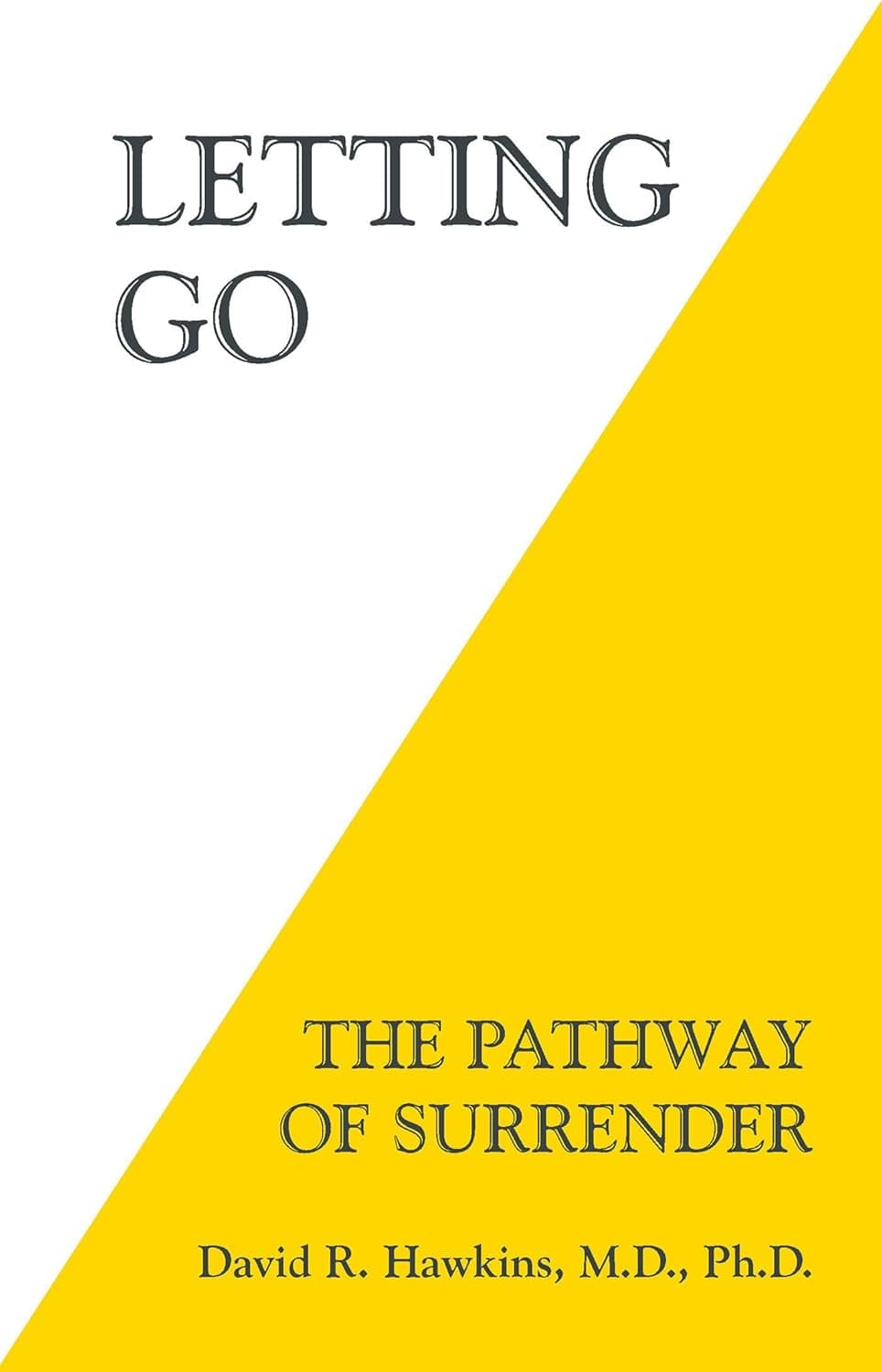
Letting Go: The Pathway of Surrender
Synopsis
Letting Go presents David Hawkins' method for releasing emotional attachments and limiting beliefs through a practice he calls surrender. Rather than analyzing feelings, resisting them, or trying to replace them with positive thoughts, Hawkins proposes a simple mechanism: allow the feeling to be present without wanting to change it, and let it run its course until it naturally dissolves. The book maps emotions on a scale from shame to enlightenment, showing how each level constrains perception and possibility. Hawkins distinguishes between the transient emotion itself and the underlying energy driving it, arguing that we can release the energy by fully experiencing and allowing the feeling without attachment to its story or meaning. The approach is experiential rather than intellectual, focused on direct practice rather than understanding why feelings arise. Hawkins draws on his background in psychiatry and consciousness research to explain the mechanics of emotional release, offering a technique applicable to everything from minor irritations to deep-seated trauma. The writing is clear and practical, with examples showing how letting go operates in everyday situations and what shifts become possible when emotional baggage is progressively released.
Philosophical Vectors
Personal Synthesis
"Letting Go gave me a tool that actually works for emotional processing. Hawkins' method operates differently from cognitive reframing or positive thinking. It's not about changing your thoughts or managing feelings. It's about allowing them completely and letting them dissolve on their own. The technique is almost absurdly simple. When a feeling arises, you welcome it, allow it to be present fully without resistance, and observe it without engaging the story about why you feel this way. You stay with the physical sensation in your body and let it run its course. What I've found is that feelings, when allowed rather than resisted, actually dissipate relatively quickly. The suffering comes from holding on, not from the feeling itself. The distinction between the feeling and the story about the feeling was crucial. Hawkins shows you can release the emotional charge without needing to resolve the narrative at all. The story often dissolves once the energy underneath it is gone. This saved me from endless analytical loops that went nowhere. What makes the practice challenging is its simplicity. There's no complex protocol. You just let go. But actually doing that, especially with intense feelings, takes willingness and practice. I found myself wanting to understand or fix rather than simply allow. I've applied this to everything from daily irritations to deeper patterns around self-worth and relationships. Things that used to trigger intense reactivity now generate responses I can feel and release relatively quickly. Chronic anxieties I'd carried for years have diminished significantly. The shifts are real and measurable in how I experience day-to-day life. Letting Go is a practical manual for emotional release that treats feelings as energy to be experienced and discharged rather than problems to be solved. That shift in approach has been genuinely transformative for me."