Energy Map

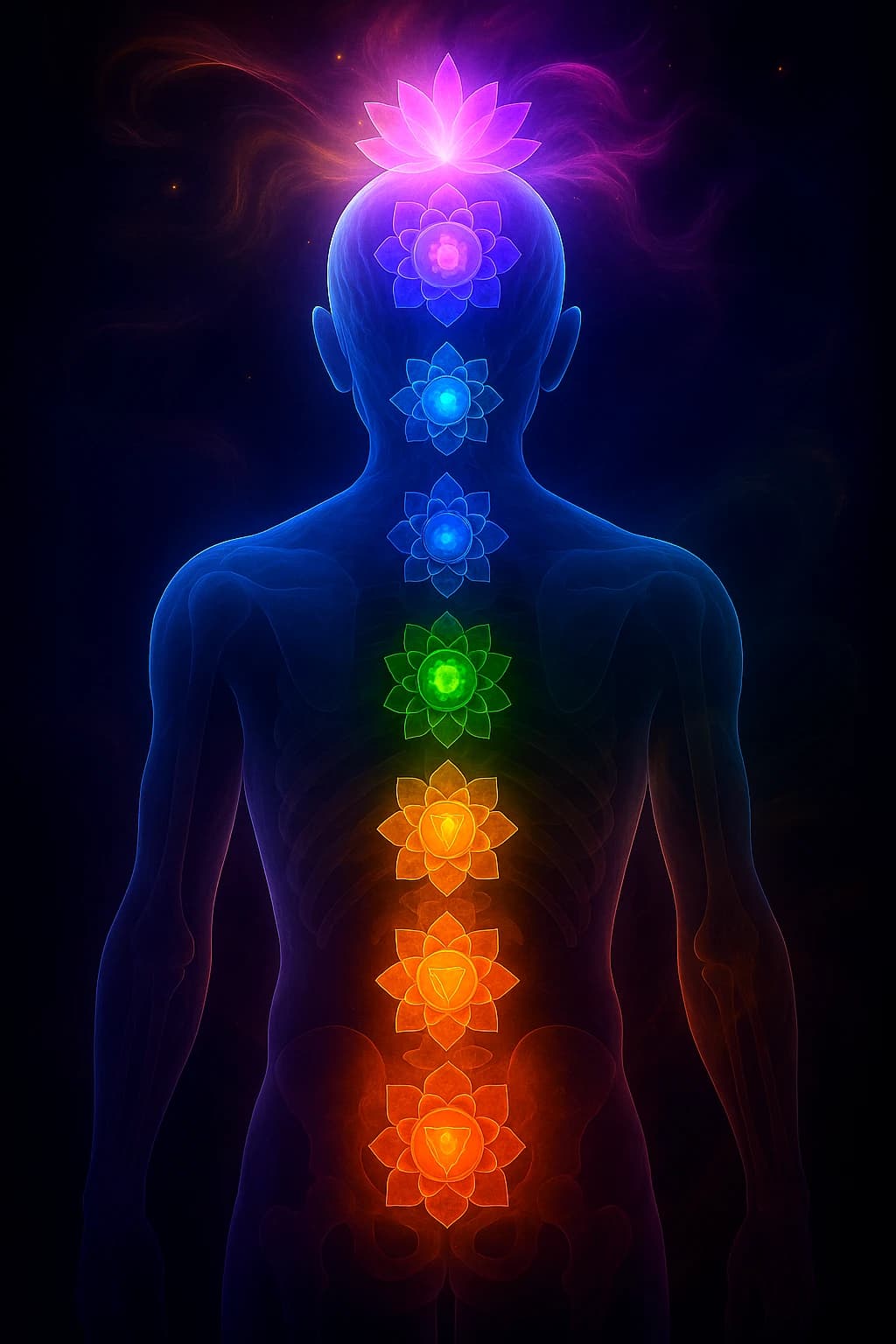
Interactive chakra energy map showing the seven centers of consciousness from root to crown

Visualize the interconnected flow of consciousness through your primary energy centers.

AWAITING NEURAL INPUT...

Understanding Chakras

Chakras are energy centers within the body that represent different aspects of consciousness and spiritual development. They act as a bridge between the physical and spiritual realms, helping you connect with yourself and the greater universe.

What Are Chakras?

Think of chakras as vibrational energy points within the body, similar to notes in a musical scale or colors in a rainbow. Each chakra reflects a specific area of life and consciousness, progressing from foundational survival needs to higher spiritual connection.

Using the Energy Centers

The chakras guide spiritual evolution, starting at the root (basic needs and survival) and ascending to the crown (unity and infinite connection). Balancing these centers allows energy to flow freely, fostering emotional, physical, and spiritual harmony.

A Practical Approach

Begin with the lower chakras (red, orange, yellow) to establish a strong foundation before working on the higher centers (green, blue, indigo, violet). Meditate, reflect, and practice self-awareness to release blockages and align your energy.

Ego vs. True Self

Two modes of experiencing reality. The localized self vs. universal consciousness. Hover to compare.

Me

The localized self. Identity through separation.

The True Self

The unbounded self. Identity through connection.

Me

  • ego:true
  • duality:true
  • time:linear
  • identity:individual
  • perception:limited
  • purpose:self-preservation
  • awareness:localized
  • emotions:fear, desire, attachment
  • connection:separated
  • focus:external
  • creation:by action

Chakra Questions

Common questions about the seven chakras, their role in consciousness, and how to work with them.

The seven chakras are energy centers that run along the spine, from the base (Root) to the top of the head (Crown). Each one corresponds to a different aspect of consciousness: survival and grounding (Root), creativity and emotion (Sacral), personal power (Solar Plexus), love and compassion (Heart), communication and truth (Throat), intuition and insight (Third Eye), and spiritual connection (Crown). They represent a map of how awareness expresses itself through the body.
If consciousness is fundamental to reality, as analytic idealism suggests, then chakras can be understood as the way universal consciousness differentiates itself through individual experience. Each chakra represents a frequency or mode of awareness, from the most grounded and physical (Root) to the most expansive and unified (Crown). Rather than being purely physical structures, they describe how consciousness organizes itself at different scales of human experience.
The chakra system originated in ancient Indian traditions and does not have direct support from mainstream Western science. However, each chakra corresponds to major nerve plexuses and endocrine glands in the body, and the progression from survival instincts to higher cognition mirrors well-established models of psychological development. Researchers exploring the relationship between consciousness and the body, including those working in quantum consciousness, find the chakra framework a useful map for understanding how awareness interacts with physiology.
The hard problem asks why physical processes give rise to subjective experience. The chakra system offers a complementary perspective: rather than consciousness emerging from matter, each chakra represents a lens through which fundamental consciousness expresses itself. The Root chakra filters awareness into survival instincts, the Heart into compassion, the Crown into unity. This framework treats experience as primary, which aligns with idealist approaches to the hard problem.
Chakra meditation typically involves focusing attention on each energy center in sequence, from root to crown. Each chakra has a seed mantra (Lam, Vam, Ram, Yam, Ham, Om) that can be used as a focal point. The practice is less about forcing balance and more about bringing awareness to where energy feels blocked or overactive. Regular meditation on the chakras develops sensitivity to the body as a field of consciousness rather than just a physical object.
The lower chakras (Root, Sacral, Solar Plexus) deal with physical survival, emotional connection, and personal identity. The higher chakras (Throat, Third Eye, Crown) deal with expression, perception beyond the senses, and unity with the whole. The Heart chakra sits at the center, bridging the two. This progression mirrors the evolution of consciousness from individual self-preservation toward the recognition of interconnectedness that traditions like Advaita Vedanta and quantum consciousness models describe.
Working with the chakra system is fundamentally a practice of expanding awareness. As attention moves from lower to higher centers, perception shifts from identifying with the individual self toward recognizing consciousness as something larger. Many contemplative traditions describe this shift as moving from ego-identification to awareness of the true self. Whether framed through Eastern philosophy or Western consciousness science, the direction is the same: perception is not fixed, and the quality of your awareness shapes the reality you experience.

Stay Curious

New essays on consciousness, perception, and the questions worth sitting with. Delivered to your inbox when they are ready.